
Download the worksheet
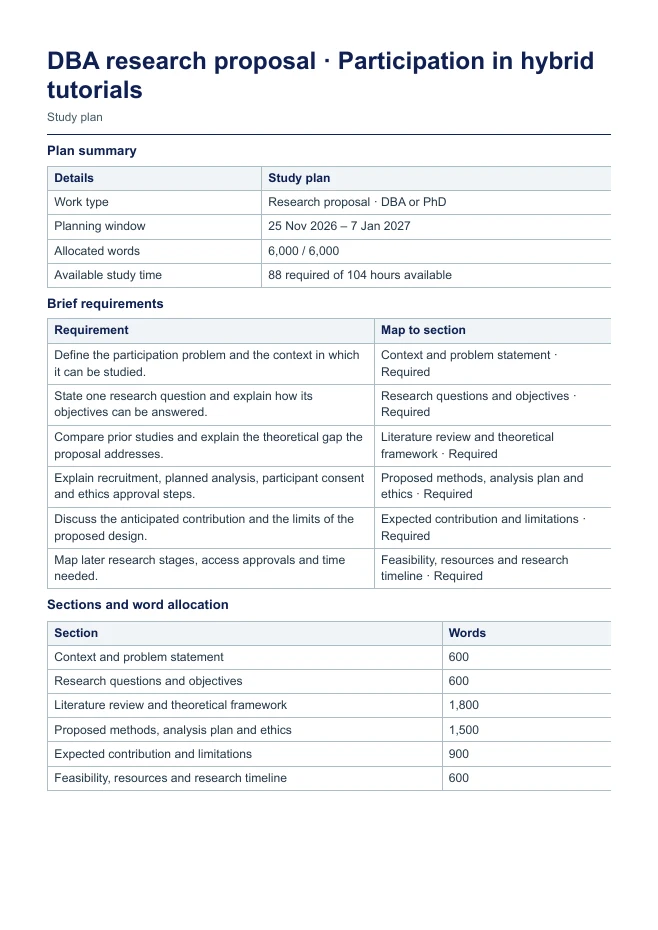
Worked doctoral proposal plan
See the 6,000-word allocation, section prompts and a six-week schedule. Adapt the editable Word plan to your programme.
Turn the programme brief into decisions
Record the applicable handbook or rubric and mark which sections count towards the word limit. Write each requirement in your own words and give it a place in the outline. Use the wording of the brief for required headings and confirm the submission date and whether there will be a proposal defence.
Ask your supervisor to review the parts that affect the whole plan first. In this example, those are the unit of analysis, what counts as participation and whether the candidate can recruit through the university. A later change to any of these can change the method, consent materials and timetable.
Pair the question with the evidence it needs
“How does hybrid teaching affect student participation?” leaves the setting, the comparison and the meaning of participation open. A narrower question is “How do first-year students in two hybrid tutorials describe the choices they make between speaking, posting in chat and remaining silent?” It identifies a group, setting and behaviour.
Interviews could reveal why participants chose a channel. Observations, where approved, could describe how those channels were used. If the question instead asked whether hybrid teaching increases participation, the candidate would need a defensible comparison and a consistent measure across formats. The proposed interview study supports a different claim.
Allocate 6,000 words to the work the reader must assess
- Context and problem statement · 600 words. Explain why speaking and contributing are distinct in a hybrid tutorial and which decisions depend on that distinction.
- Questions and objectives · 600 words. State the main question and show which objective examines participation choices and which examines conditions shaping them.
- Literature and framework · 1,800 words. Compare how earlier studies define and measure participation. Use those differences to explain what the proposed study can add.
- Methods, analysis and ethics · 1,500 words. Explain eligibility, recruitment, consent, data handling and how interview responses will be coded and compared. Include how you will consider responses that challenge your initial interpretation.
- Expected contribution and limits · 900 words. Explain which tutorial design decisions the study may inform and how a small, local sample limits the conclusions.
- Feasibility, resources and timing · 600 words. Record future permissions and decision dates, access needed, who can confirm them and how you will revise the design if access changes.
Separate proposal writing from the future study
The worked six-week proposal plan allocates 88 hours from 104 available. The candidate first resolves the question and reviews the literature, then drafts the method and sends a reviewable draft with a short list of questions. The remaining work covers revisions, final checks and a buffer. Count study hours you can realistically protect, including commitments around work or teaching.
A separate four-month study schedule might allocate month one to finalising the protocol and obtaining the required approvals. Month two covers recruitment and a small trial of the interview guide after approval. Month three covers interviewing and early coding. Month four covers comparison, interpretation and writing. If approval slips, move dependent work, ask the supervisor which activities can continue and revise the final date together.
Send a focused draft for supervisor feedback
Send the research question, the planned evidence, your reason for choosing the method and what the design can support. For example, ask “Should I keep two tutorials with the same delivery format to make accounts more comparable, or include two distinct formats and explicitly treat those differences as context?” Record the decision, the reason and the parts of the proposal it changes.
Sources
Frequently asked questions
Is 6,000 words a standard requirement for every doctorate?
This is the word budget for the worked example. Use your programme’s current word limit, counting rules and required headings.
Do I need results in a doctoral proposal?
Explain what your proposed study would examine and how you would analyse the evidence. Where your programme asks for preliminary work, describe what has actually been done and follow the relevant approval requirements.
What if I cannot secure access before the proposal deadline?
State which access is pending, who can authorise it and the point at which the design must change. Discuss an alternative that you could pursue with proper approval.