
Download the worksheet
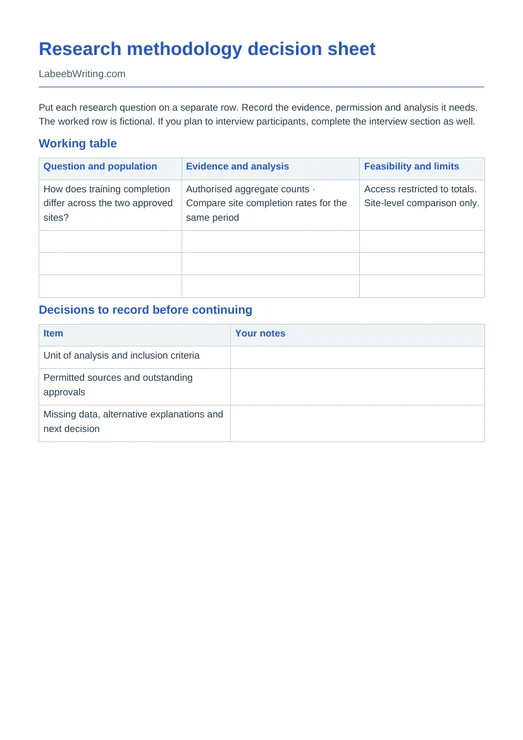
Research methodology decision sheet
Connect each question to available data, an analysis plan and the limits on the conclusion.
Decide what the question actually asks
“How do new teachers describe their use of feedback?” asks about experience and may suit interviews with a clear sampling rationale. “Is feedback frequency associated with retention?” requires a defined population, a measure for each variable and an analysis plan. An observed association can have other explanations.
Write the chain from question to evidence
- Define the population or material, inclusion criteria and unit of analysis. Distinguish a person, an observation and a group.
- Name the data source, collection method, instrument and intended analysis. Explain which evidence would answer each question.
- Check recruitment, permissions, ethics, storage and time. Record assumptions about missing or incomplete evidence.
- State the extent of the claim you can make and the alternative explanations you cannot rule out.
Resolve feasibility before promising collection
A team wants to compare completion records across departments. The data owner can release only counts by site. That changes the unit of analysis and prevents linking individual working patterns to completion. A credible proposal narrows the question to site-level differences, or obtains approved access before making the individual-level claim.
Plan what to discuss with a supervisor or analyst
Bring the draft question, a description of the intended sample, a variable dictionary or example evidence, the proposed time horizon and the questions you have about analysis. For a mixed-methods design, say where the two strands meet and how disagreement will be investigated. Follow your institution’s approval and data handling process before working with restricted data.
Use a claim to test whether the design fits
Suppose a postgraduate student wants to know whether shorter tutorials improve attendance. Two course sections offer usable attendance logs, but the schedules and instructors differ. The records can describe what attendance looked like in each section. A claim about what caused the difference needs a design that addresses plausible alternatives, including scheduling and student choices.
If the project instead asks how students experienced the shorter sessions, a scoped interview study can examine their accounts. It requires an explicit sample, a workable interview approach, institutional permissions and a plan for interpreting the material. It answers a different question from the attendance comparison.
Verify what each part of the design can deliver
- Unit of analysis. A student, a tutorial session and a department represent different kinds of observation. State the unit in the question and identify which records correspond to it.
- Sampling and access. Write down who could be included, how the project will reach them, who cannot be included, and which approval is needed. Recheck the deadline against the approval window.
- Measures and missing data. Define attendance or engagement before comparing groups. Separate sessions with missing records from genuine absences. Record why any data was excluded and what that changes.
- Analysis. Describe what result would answer the question and what other explanations remain. Use that decision to choose an analysis you can carry out and explain to a supervisor.
Prepare a fallback before committing
If individual records are unavailable, use approved aggregate data only if a scoped group-level question fits the assessment. If the required approval arrives too late, check whether the programme would accept a design proposal or a secondary analysis using an approved public dataset. Keep the fallback and the approval decision in the method worksheet.
Pilot a semi-structured interview guide
In this fictional example, a researcher asks how employees in their first month learn to hand over work between shifts. Interviews can show which instructions or routines staff describe as helpful, unclear or missing. To estimate how often handovers are incomplete, use a separate measure and sampling plan.
Open with “Think of a handover when you were still learning the routine. What happened from start to finish?” Ask everyone about a recent handover and keep the core topics consistent. Choose follow-ups based on the participant’s answer.
| Draft wording | Revision | Language version | Reason and decision |
|---|---|---|---|
| “How did poor communication affect your first handovers?” | “Think of a handover when you were still learning the routine. What happened from start to finish?” | English and Arabic | The draft assumes there was a problem. Use the neutral opening in both versions and rehearse each version. |
- Ask “What helped you decide what to pass on, if anything?” If the participant mentions asking someone for help, follow with “What happened after you asked?” Invite a concrete example without asking for names.
- If your programme permits it, rehearse with a colleague using an invented scenario and collect no research data. Check what each version of the question means to the listener, how long it takes and whether the probes interrupt the account. Log what you change and why. Confirm the approval requirements for any pilot involving research participants.
Confirm approval and recording arrangements
Before recruiting, piloting with research participants or recording, check the requirements of your programme and the workplace. Use the authorised recruitment process, participant information and consent materials. Explain the scope of the interview, that participation is voluntary and how a participant can skip a question or stop. Check whether changing approved questions or recording arrangements requires a further review.
If the approved plan allows recording, ask for consent to record before starting. If someone declines, follow the agreed alternative, such as taking notes when permitted. Record the consent decision and follow the approved storage and access arrangements. Add rehearsal and approval checkpoints to your project plan.
Sources
- University of Sheffield guide to identifying research methods
- University of Southern California Libraries methodology guide
- GOV.UK guidance on planning and testing in-depth interviews
- University of Bath guidance on interviewing and recording
- NYU Abu Dhabi research ethics applications and protocol changes
Frequently asked questions
Is a larger sample always the answer?
Sample requirements depend on the design, intended inference, data quality and uncertainty. Discuss sampling and the power or precision requirements appropriate to your study with your supervisor or analyst.